<?xml version="1.0" encoding="utf-8"?><feed xmlns="http://www.w3.org/2005/Atom" ><generator uri="https://jekyllrb.com/" version="3.10.0">Jekyll</generator><link href="https://tams.org/feed.xml" rel="self" type="application/atom+xml" /><link href="https://tams.org/" rel="alternate" type="text/html" /><updated>2026-09-09T16:35:08+00:00</updated><id>https://tams.org/feed.xml</id><title type="html">TAMS</title><subtitle>TAMS (Time Addressable Media Store) is an open-source API specification for storing media as time-addressable chunks in commodity object storage.</subtitle><entry><title type="html">IBC 2026 TAMS Locations</title><link href="https://tams.org/2026/09/07/IBC2026/" rel="alternate" type="text/html" title="IBC 2026 TAMS Locations" /><published>2026-09-07T00:00:00+00:00</published><updated>2026-09-07T00:00:00+00:00</updated><id>https://tams.org/2026/09/07/IBC2026</id><content type="html" xml:base="https://tams.org/2026/09/07/IBC2026/"><![CDATA[<p>IBC 2026 is rapidly approaching and in anticipation we’ve put together a list of some of the places around the show where you can see or talk about the latest developments in the TAMS eco system.  This year we’re including not just stands where you can see demonstrations, but also talks and awards.</p>

<p>If you would like your session included on this list then please let us know in the TAMS Slack.</p>

<p><strong>On this page</strong></p>

<ul>
  <li><a href="#awards">Awards</a></li>
  <li><a href="#talks">Talks</a></li>
  <li><a href="#demonstrations">Demonstrations</a></li>
</ul>

<h2 id="awards">Awards</h2>

<h3 id="ibc-innovation-awards-2026">IBC Innovation Awards 2026</h3>

<p>The Reuters and TVU Networks’ project, “Capacity that follows the live news story”, has been named a finalist in the IBC Innovation Awards 2026 in the Content Distribution category.</p>

<p><a href="https://www.tvunetworks.com/story/reuters-and-tvu-networks-introduce-scalable-live-workflows-for-on-demand-news/">https://www.tvunetworks.com/story/reuters-and-tvu-networks-introduce-scalable-live-workflows-for-on-demand-news/</a></p>

<h2 id="talks">Talks</h2>

<h3 id="friday-11th">Friday 11th</h3>

<h4 id="1500--stop-copying-media-tams-for-open-ai-ready-media-workflows-content-everywhere-stage-2">15:00:  Stop Copying Media: TAMS for Open, AI-Ready Media Workflows (Content Everywhere Stage 2)</h4>

<p>Why does every workflow still need its own copy of the media? In this session, Oracle Cloud Infrastructure and Norsk explore how TAMS enables a more open model: store media once, make it accessible across workflows, and give broadcasters more choice in the tools and partners they use. The result is less duplication, faster access, and more flexibility across clipping, replay, publishing, archive, analytics, and emerging AI-enabled media operations. Rather than locking media into closed silos, TAMS points to a practical cloud foundation for simpler operations, greater customer choice, and faster innovation. Discover why time-addressable media is emerging as a smarter foundation for the next generation of media workflows.</p>

<h3 id="saturday-12th">Saturday 12th</h3>

<h4 id="1330--how-synchronisation--alignment-of-media-works-in-dmf-and-tams-and-how-they-work-together-ebu---10d21">13:30:  How synchronisation &amp; alignment of media works in DMF and TAMS, and how they work together (EBU - 10.D21)</h4>

<p>Ask-me-anything session on sync and timing in TAMS, JT-DMF and across the supply chain, with BBC R&amp;D’s Robert Wadge</p>

<h4 id="1500--how-yahoo-studios-built-cloud-native-media-workflows-with-tams-on-aws-aws---5c90">15:00:  How Yahoo Studios Built Cloud-Native Media Workflows with TAMS on AWS (AWS - 5.C90)</h4>

<p>Liam Mulvey and Dan Brantigan from Yahoo Studios demonstrate the end to end workflow they have built on TAMS to take content from their studios through to their website.</p>

<h4 id="1530--capacity-that-follows-the-story-tvu-networks---5b86">15:30:  Capacity that follows the story (TVU Networks - 5.B86)</h4>

<p>Reuters News Agency joins TVU Networks, InSync Technology Ltd and Kinetiq, alongside a representative from the TAMS community, for a live conversation about a different approach to live news infrastructure: Capacity follows the story.</p>

<p>We’ll go behind a new approach Reuters and TVU Networks are developing for live news distribution — exploring how workflows, processing and services can be dynamically assembled around the needs of each event, with capacity able to scale as demand changes.</p>

<p><a href="https://hubs.li/Q04wd8Dd0">https://hubs.li/Q04wd8Dd0</a></p>

<h4 id="1600--smart-stories---the-new-knowledge-architecture-for-content-production-future-tech-stage">16:00:  Smart Stories - The New Knowledge Architecture for Content Production (Future Tech Stage)</h4>

<p>Every newsroom runs on integration. Decades of it teaching our systems to talk to each other. None of it taught them what the story means. As those systems become intelligent, that context, currently lost at every handoff, becomes foundational. Join us for this exclusive, world-premiere of our IBC Accelerators’ new 2026 Incubator “Smart Stories”, as this multi-award-winning, truly global team reveals the fast-track R&amp;D that built SOM, the Story Object Model: an open standard that makes the story a first-class object systems subscribe to. Its state, its sources, its assets. The integration layer for the agentic era.</p>

<p><a href="https://show.ibc.org/ibc2026/accelerators-frames-federated-retrieval-agentic-media-environment-and-software-defined-workflows?&amp;sortby=customfield_13183%20asc%2Ctitle%20asc&amp;searchgroup=libraryentry-ibc2026">IBC website</a></p>

<h4 id="1600--tamoss-at-the-ebu-open-source-meetup-ebu---10d21">16:00:  TAMOSS at the EBU Open Source Meetup (EBU - 10.D21)</h4>

<p>The EBU Open Source Meetup will again be held during IBC at the EBU’s stand (10.D21) and is a great place to learn about some of the latest updates from your favourite open source media projects, as well as learn about new initiatives.</p>

<p>The format is a series of short (5m) pitches on open source projects for media and broadcasting, spanning audio and video, software and hardware.</p>

<p>This year’s programme includes TAMOSS - Kubernetes-native implementation of the BBC’s Time-addressable Media Store API; a common foundation for building fast-turnaround media workflows.</p>

<p><a href="https://tech.ebu.ch/events/2026/open-source-meetup-ebu-ibc-2026">https://tech.ebu.ch/events/2026/open-source-meetup-ebu-ibc-2026</a></p>

<h3 id="sunday-13th">Sunday 13th</h3>

<h4 id="1515--trust-provenance-and-authenticity-conference-room-2">15:15:  Trust, Provenance and Authenticity (Conference Room 2)</h4>

<p>This panel session will have two presentations followed by a panel discussion with a range of experts working in the field. The first is a presentation from an international project on the first standardised framework for implementing C2PA for media provenance across newsrooms of varying sizes and operational contexts. The second is from Reuters News and Media Ltd on the four open standards that collectively address the issues around trusted news content: the EBU Dynamic Media Facility, the Media eXchange Layer (MXL), the Time-Addressable Media Store (TAMS) API, and the Coalition for Content Provenance and Authenticity (C2PA) specification.</p>

<p><a href="https://show.ibc.org/ibc2026/trust-provenance-and-authenticity-1">https://show.ibc.org/ibc2026/trust-provenance-and-authenticity-1</a></p>

<h4 id="1130--tams-and-how-it-fits-with-dmf-ebu---10d21">11:30:  TAMS and how it fits with DMF (EBU - 10.D21)</h4>

<p>Ask-me-anything session on how TAMS fits with the Dynamic Media Facility initiative, with TAMS TSC chair Sam Mesterton-Gibbons</p>

<h4 id="1300--live-tamoss-build">13:00:  Live TAMOSS build</h4>

<p>In this 30-minute slot we will install the TAMOSS operator on a real Kubernetes cluster and bring up a store. We will then connect the store to CuttingRoom Reporter and CuttingRoom Editor, using Backblaze as the S3 storage behind it. The deployment is configured against external PostgreSQL, S3 storage and an OIDC provider, making the underlying deployment Kubernetes-stateless.</p>

<p>The session is aimed at anyone who wants to see a complete install before attempting one on their own infrastructure.</p>

<p><a href="https://livewyer.io/blog/livewyer-brings-open-source-tams-to-ibc-2026-with-tamoss/">https://livewyer.io/blog/livewyer-brings-open-source-tams-to-ibc-2026-with-tamoss/</a></p>

<h3 id="monday-14th">Monday 14th</h3>

<h4 id="1200--open-media-architectures-aws---5c90">12:00:  Open Media Architectures (AWS - 5.C90)</h4>

<p>The media industry is shifting from monolithic, proprietary systems toward open, modular architectures that decouple content storage, processing, and distribution into interoperable layers. This approach enables organisations to compose best-of-breed tools, accelerate innovation, and integrate AI natively across production workflows — from ingest through to delivery.</p>

<p>This is being driven by open-source initiatives including TAMS (Time Addressable Media Store) which reimagines cloud storage as a real-time media platform, and MXL (Media eXchange Layer) providing standardised transport between media services.  Together they illustrate how open architectures reduce vendor lock-in, lower integration costs, and empower media organisations to evolve at the pace of technology rather than procurement cycles.</p>

<p>With John Biltcliffe (AWS), Chris Swan (AWS) and Sam Mesterton-Gibbons (BBC R&amp;D)</p>

<h2 id="demonstrations">Demonstrations</h2>

<h3 id="2wcom-systems-gmbh-8d81---new">2wcom Systems GmbH (8.D81) - New</h3>

<p>We will show our IP-4c Audio over IP codec with TAMS integration</p>

<p><a href="https://www.2wcom.com/">https://www.2wcom.com/</a></p>

<h3 id="3adesign--phrame---new">3adesign / Phrame - New</h3>

<p>3adesign is showcasing Phrame, a cloud-native media platform with native support for TAMS. Phrame delivers compliance recording, monitoring and browser-based media workflows as ready-to-deploy solutions, with every recording, review and playback pointing directly at time-addressable media in place: no duplicate files, no proprietary silos. Broadcasters get continuous compliance recording and monitoring running alongside live production, with instant browser access to any point on the timeline. On the live side, Phrame’s services exchange frames over a shared-memory frame bus built on MXL and VDI, alongside NDI and SMPTE 2110 for standards I/O. So, whether media is moving between production services or landing in the TAMS store, Phrame relies on open, vendor-neutral interconnects rather than proprietary ones. Come and see how a genuinely TAMS-first platform simplifies compliance and monitoring without creating another media silo.</p>

<p><a href="https://phrame.cloud/">https://phrame.cloud/</a></p>

<h3 id="aws-5c90">AWS (5.C90)</h3>

<p>This year, rather than a standalone TAMS demo pod, TAMS serves as a foundational layer underpinning several demonstrations across the AWS booth — reflecting its growing role as core infrastructure for modern media workflows. In Re-inventing Linear Contribution &amp; Distribution on AWS, TAMS powers both ingest and fast-turnaround workflows feeding directly into linear channel playout, demonstrating how cloud-native media storage can streamline traditional broadcast chains. The Adopting MXL for Live Cloud Production demo showcases TAMS playback and recording as part of a wider, gallery-based live production environment built on the MXL standard, illustrating how TAMS and MXL work together as complementary technologies for cloud-based production. And in Smart Stories: The Agentic Production Ecosystem, developed through the IBC Accelerator programme, TAMS acts as the media store alongside the SOM bus as the story context layer, enabling next-generation news workflows that include AI-driven understanding of TAMS content, AI-assisted story writing, and automated publishing to multiple endpoints.</p>

<p>Beyond the demos, TAMS also features in the AWS booth theatre programme, with a session from Yahoo on Saturday and an Open Media Architectures session on Monday lunchtime exploring the broader ecosystem around TAMS. Visitors looking to get hands-on will also find Logic Media and Merapar on the AWS booth — both systems integrators with live TAMS demonstrations and real-world experience building with TAMS, ready to help customers looking to adopt it in their own environments.</p>

<p><a href="https://aws.amazon.com/events/ibc-2026/">https://aws.amazon.com/events/ibc-2026/</a></p>

<h3 id="bcnexxt">BCNEXXT</h3>

<p>Vipe from BCNEXXT now supports TAMS.</p>

<p>TAMS aligns directly with BCNEXXT’s principals of openness, agility, scalability and performance and by switching to utilizing native TAMS on object storage, BCNEXXT expects to rapidly develop new functionality such as a comprehensive ‘lines’ recording and subsequent content management functionality for Vipe, becoming a major enabler for BNCEXXT’s ‘record once and use many times’ philosophy.</p>

<p><a href="https://www.bcnexxt.com/">https://www.bcnexxt.com/</a></p>

<h3 id="broadcast-bionics-8f40---new">Broadcast Bionics (8.F40) - New</h3>

<p><strong>MOR&gt; Multi Object Recorder</strong> is built for radio and podcast workflows, synchronising free-running cameras to PTP-locked audio and capturing every source as a reusable media object. Rather than creating only a finished programme, it writes synchronised video, audio and metadata directly into a TAMS store for immediate search, AI inference, editing and repurposing.</p>

<p><strong>Creator Node</strong> connects a RØDECaster directly into professional AoIP infrastructure, carrying multichannel audio and GPIO between the desktop production environment and the wider broadcast network. At the same time, it enables multitrack recording straight from the RØDECaster into a TAMS store, preserving individual microphones, programme audio and other sources for immediate reuse, search, AI processing and repurposing.</p>

<p><a href="https://www.bionics.co.uk">https://www.bionics.co.uk</a></p>

<h3 id="cuttingroom-1d20---updated">CuttingRoom (1.D20) - Updated</h3>

<p>CuttingRoom works natively with TAMS, with no duplication of files. Add as many TAMS stores you need, and access them all directly from the award winning CuttingRoom Cloud Editor. TAMS sources can grow both in the source player and on your timeline, so you can edit the way you prefer. In addition you can record to TAMS natively from the field using the CuttingRoom Reporter iPhone app. CuttingRoom has often been used to verify new TAMS implementations, as we were among the first to support it. CuttingRoom is known for the many out-of-the-box integrations with MAM/PAMs (like Avid, Iconik, Mimir and many more), cloud storages (like AWS S3, StoreJ, Backblaze and many more) and has a pluggable AI assistant, ShortCut, that customers can train to their specific needs. All our tools are up to date with TAMS 8.2</p>

<p><a href="https://www.cuttingroom.com/">https://www.cuttingroom.com/</a></p>

<h3 id="gv-9a01---new">GV (9.A01) - New</h3>

<p>“This is not another TAMS connector demonstration. Grass Valley will showcase a fully integrated content supply chain that brings TAMS media registration directly into the production workflow, from ingest and edit through to rendering and distribution.</p>

<p>The Elastic Recorder workload (scalable distibuted ingest) ingests and registers media into TAMS, Framelight X provides the editorial experience with Search, Discovery and remote browser/Premiere Edit, before FLARE rendering handles final rendition and output.</p>

<p>Framelight X abstracts the underlying storage environment, allowing editors to work seamlessly with traditional local or remote storage alongside time-addressable media in TAMS all as a combined content and editing workflow. This enables organisations to adopt TAMS without disrupting established creative processes or creating another workflow for users to manage.”</p>

<p><a href="https://www.grassvalley.com/products/ampp/framelight-x/">https://www.grassvalley.com/products/ampp/framelight-x/</a></p>

<h3 id="hiscale-1f17---new">Hiscale (1.F17) - New</h3>

<p>New at IBC: Hiscale FLICS Live Ingest can now record live streams directly into TAMS.</p>

<p>FLICS captures IP-based sources including SRT, NDI, HLS, MPEG-TS and RTMP, and makes the incoming content available through TAMS while it’s still being recorded. This means other applications and workflows can start accessing and working with the content straight away.</p>

<p>A simple way to connect live ingest with open, TAMS-based media workflows.</p>

<p><a href="https://www.hiscale.com">https://www.hiscale.com</a></p>

<h3 id="liveu-7c24---new">LiveU (7.C24) - New</h3>

<p>LiveU is demonstrating its development of TAMS as part of the LiveU EcoSystem, enabling continued interoperability and industry openess, in conjunction with the SOM IBC Accelerator for both Live and File based workflows.</p>

<p><a href="https://www.liveu.tv/">https://www.liveu.tv/</a></p>

<h3 id="livewyer---new">LiveWyer - New</h3>

<p>Live TAMOSS recordings and interviews to a publicly available TAMS Store</p>

<p>On each of the three days we will be walking the halls recording interviews with exhibitors and visitors. Each interview is captured on CuttingRoom Reporter and uploaded directly into a public TAMOSS store that we run for the show. There is no memory card to offload and no file to copy between systems. As soon as an interview is in the store, anyone with the link can browse it and play it back, or pull it into an edit or QC tool over the TAMS API.</p>

<p>Come and find us if you would like to be interviewed. If you would rather watch, ask us for the link to the store and you can follow the interviews as they are added over the three days.</p>

<p><a href="https://livewyer.io/blog/livewyer-brings-open-source-tams-to-ibc-2026-with-tamoss/">https://livewyer.io/blog/livewyer-brings-open-source-tams-to-ibc-2026-with-tamoss/</a></p>

<h3 id="logic-media-solutions-gmbh-5c90---updated">LOGIC media solutions GmbH (5.C90) - Updated</h3>

<p>LOGIC will be present at IBC 2026 as a co-exhibitor at the AWS booth 5.C90, showcasing an end-to-end reference architecture for a modern highlight platform built on TAMS.</p>

<p>Acting as the integrator, LOGIC demonstrates how the full solution package comes together across ingest, event processing, AI-assisted analysis, orchestration, editorial approval, rendering, and delivery preparation.</p>

<p>The showcase highlights how audio, video, and metadata streams can be brought into a scalable cloud-based workflow that supports faster and more efficient highlight production without losing operational control.</p>

<p>Particular emphasis is placed on the modular architecture approach, where clearly separated solution packages are combined into one integrated platform while remaining flexible for future extension. The concept illustrates how existing media and production environments can be enhanced step by step with automation, governance, and scalable processing capabilities.</p>

<p><a href="https://logic.tv">https://logic.tv</a></p>

<h3 id="matrox-video-7b15---updated">Matrox Video (7.B15) - Updated</h3>

<p>Matrox ORIGIN is a development framework for rapidly building media applications using a REST-based API. 
It’s an open and extensible system that allows developers to build their own media processing functions with a laser focus on their specific concerns, as control state is managed by the framework. 
It includes a large number of media processing functions, including clip players, mixers, SRT, and much more.</p>

<p>For IBC 2026, we made some improvements to our TAMS reader and writer, now supporting “Play while Record” workflows; this allows for quick-turnaround capture and replay within ORIGIN.</p>

<p>There is demonstration of the Matrox TAMS playback and record features on the Matrox (7.B15) and AWS (5.C90) booths.</p>

<p><a href="https://video.matrox.com/en/product/broadcast-developer/origin-framework/">https://video.matrox.com/en/product/broadcast-developer/origin-framework/</a></p>

<h3 id="mavis-10a41---updated">Mavis (10.A41) - Updated</h3>

<p>“Mavis Camera is a powerful professional camera app for iPhone, designed to connect a wide range of acquisition sources directly into TAMS-based workflows.</p>

<p>In this demo, we extend our existing camera-to-cloud technology with native TAMS support across multiple video sources. Content can be captured using the iPhone’s built-in cameras, received over NDI, or brought in from professional HDMI and SDI cameras using devices such as the Atomos Ninja Phone and Accsoon SeeMo range.</p>

<p>The result demonstrates how Mavis can bridge traditional production hardware with cloud-native workflows, bringing everything from an iPhone camera to a professional SDI source directly into TAMS, all through a device you already have in your pocket.”</p>

<p><a href="https://mavis.cloud/">https://mavis.cloud/</a></p>

<h3 id="mimir-7a53---updated">Mimir (7.A53) - Updated</h3>

<p>Here is how Mimir is transforming cloud broadcast workflows with TAMS (Time Addressable Media Store):  Instead of making file copies or duplicating proxies, Mimir sits as the intelligence and discovery layer on top of TAMS.</p>

<p>Here is what we’re showcasing:
⚡ Edit-by-Reference: Search, view, and process live MPEG-TS segments directly in object storage. without duplicate files.
🤝 Cross-Tenant Federation: Discover and share media across organizational tenants with unified credentials and rights auditing.
🛠️ Tooling Integration: Works seamlessly alongside craft editors like Adobe Premiere and CuttingRoom.</p>

<p>Validated in the AWS reference architecture for fast-turnaround workflows, Mimir brings intelligence, rights, and story-centric search to the TAMS ecosystem.</p>

<p><a href="https://onemimir.com/news/mimir-at-ibc-2026">https://onemimir.com/news/mimir-at-ibc-2026</a></p>

<h3 id="norsk-5a53---new">Norsk (5.A53) - New</h3>

<p>The concept behind TAMS is simple: record media once, index it against a timeline, and make it accessible to any application instantly without making duplicate copies. Rather than locking media into closed silos, TAMS points to a practical cloud foundation for simpler operations, greater customer choice, and faster innovation. And the use cases are almost endless: clipping for reuse across platforms, making assets available for VoD in multiple services, capturing video quality issues for forensic review … the list goes on. Norsk and Oracle Cloud Infrastructure will be demonstrating real-world TAMS applications in Norsk Studio — just drag a TAMS box onto a workflow and access your recordings via a straightforward player UI with seamless scrubbing. Come see the demo at the Norsk stand, 5.A53, or Oracle and Norsk’s joint presentation at 15:00 on the Content Everywhere Stage 2 (5.G72) in Hall 5.</p>

<p><a href="https://norsk.video/norsk-tams/">https://norsk.video/norsk-tams/</a></p>

<h3 id="reuters-imagen-5d44---updated">Reuters Imagen (5.D44) - Updated</h3>

<p>Live-to-Social Highlight Engine: On demand recording of live video streams into TAMS, with AI continuously analyzing the feed in real time to detect standout moments — big plays, crowd reactions, key talking points — and automatically clips them into ready-to-post highlights for social media. On stand demo, come a play e-sports, which are being streamed to the cloud using TVU to go through the above flow.</p>

<p><a href="https://imagen.io">https://imagen.io</a></p>

<h3 id="techex-2b45---updated">Techex (2.B45) - Updated</h3>

<p>Techex’s tx darwin TAMS integration provides the ingest and routing layer into a TAMS store that downstream editing and archive  tools can reach the instant they exist.</p>

<p>With Techex tx darwin’s video and audio conformance leading synchronization of multiple feeds on output to a TAMS store,  tx darwin lets broadcasters adopt vendor-agnostic, cloud-native production without re-plumbing their existing contribution workflows.
This now includes Timecode-aware media segmentation and delivery from MXL workflows.</p>

<p><a href="https://techex.tv/tams">https://techex.tv/tams</a></p>

<h3 id="tvu-5b86---updated">TVU (5.B86) - Updated</h3>

<p>TVU Networks is demonstrating TAMS in production at Reuters scale as part of Scalable Live — a cloud-native live news workflow where TVU MediaMesh writes live feeds directly into Reuters’ TAMS store for immediate AI indexing, enrichment, and journalist access. This is an end-to-end Reuters production workflow running live at IBC, where capacity follows the story rather than a fixed channel count. See it in action at Hall 5, stand B.86, or join the Scalable Live session on September 12 at 3:30 PM.</p>

<p><a href="https://www.tvunetworks.com/story/reuters-and-tvu-networks-introduce-scalable-live-workflows-for-on-demand-news/">https://www.tvunetworks.com/story/reuters-and-tvu-networks-introduce-scalable-live-workflows-for-on-demand-news/</a></p>

<h3 id="zixi-5a76---new">Zixi (5.A76) - New</h3>

<p>“ZEN Master, powered by Broadcaster v19, writes live streams directly into a TAMS (Time Addressable Media Store) as time-stamped segments that can be reached at any point on the timeline. Any Zixi input, including SRT, RIST, Zixi protocol, and HLS, becomes content addressed by time rather than by file. Teams can work with the stream while it is still being written, take only the interval they need, and build clips or edits by reference with no rendering and no file transfers. Broadcaster handles protocol reliability, timing, and packaging ahead of the store, so TAMS receives a clean, continuously timestamped record of the event.</p>

<p>The store becomes a landing point for the feeds Zixi already carries. A venue contributing over SRT or Zixi protocol lands in TAMS within seconds, so a producer can pull a replay or highlight by timestamp while the event is on air. A RIST hand-off from a partner network becomes a time-indexed record for compliance, rights review, or late-joining editors. An HLS source can be normalized by Broadcaster and stored once, then re-cut for social, syndication, or on-demand without a second transcode.The live demo shows this end to end: pick a TAMS environment and flow, watch segments appear as Broadcaster writes them, or query the store by time range, then play the results in the browser or download them stitched into a single clip.”</p>

<p><a href="https://www.zixi.com">https://www.zixi.com</a></p>]]></content><author><name>John Biltcliffe</name></author><category term="IBC" /><category term="Trade Show" /><category term="Demo" /><category term="Talks" /><category term="Awards" /><summary type="html"><![CDATA[IBC 2026 is rapidly approaching and in anticipation we’ve put together a list of some of the places around the show where you can see or talk about the latest developments in the TAMS eco system. This year we’re including not just stands where you can see demonstrations, but also talks and awards.]]></summary><media:thumbnail xmlns:media="http://search.yahoo.com/mrss/" url="https://tams.org/images/blog_images/2026-ibc-show-logo.png" /><media:content medium="image" url="https://tams.org/images/blog_images/2026-ibc-show-logo.png" xmlns:media="http://search.yahoo.com/mrss/" /></entry><entry><title type="html">TAMS has a visual identity</title><link href="https://tams.org/2026/09/02/TAMS-branding/" rel="alternate" type="text/html" title="TAMS has a visual identity" /><published>2026-09-02T08:00:00+00:00</published><updated>2026-09-02T08:00:00+00:00</updated><id>https://tams.org/2026/09/02/TAMS-branding</id><content type="html" xml:base="https://tams.org/2026/09/02/TAMS-branding/"><![CDATA[<p>TAMS — the Time-addressable Media Store — is an open specification for storing and reading media by time rather than by file. Until now, the ‘logo’ has been something we cobbled together to put on slides and stickers. That changes today.</p>

<p><img src="/images/blog_images/2026-brand-01-lockup.png" alt="The TAMS primary lockup: the segment mark beside the TAMS wordmark, white and amber on navy" /></p>

<p>The new TAMS identity is built from the specification itself. The mark is four media segments across two timeline tracks, staggered so the negative space reads as a T. There are no curves, no gradients and no illustration — just simple shapes on a grid, which means it stays legible stamped at 16 pixels, printed in a single ink, or stitched into fabric.</p>

<p><img src="/images/blog_images/2026-brand-02-construction.png" alt="The mark drawn on its 24 by 12 unit grid, showing the two 5-unit tracks and 2-unit gutters" /></p>

<p><img src="/images/blog_images/2026-brand-03-sizes.png" alt="The mark in a navy tile at 48, 32, 24 and 16 pixels, shown enlarged" /></p>

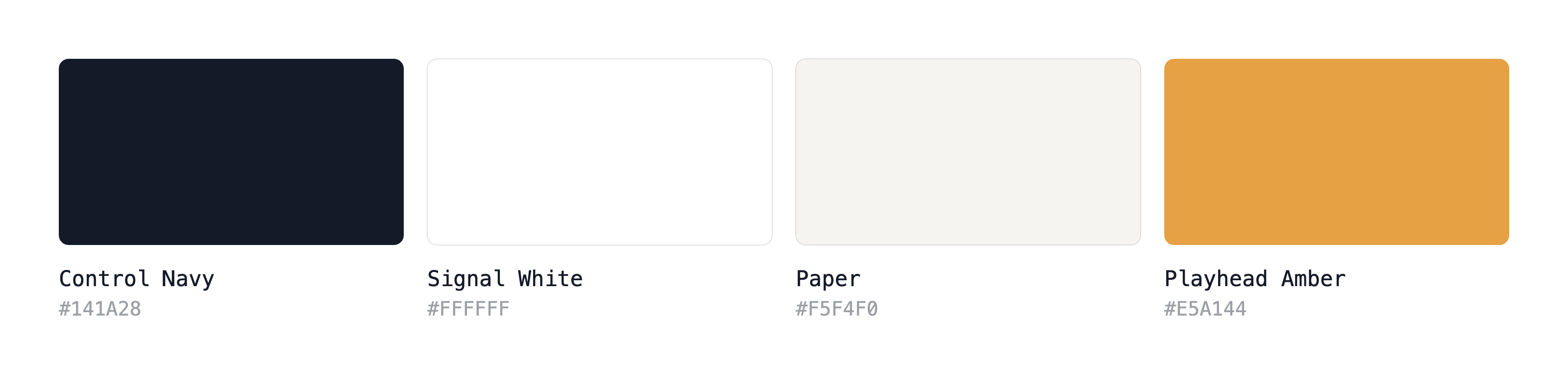
<p>The palette is a broadcast-gallery navy with one amber accent, rationed so it always signals emphasis. Typography is Geist for headings and body, IBM Plex Mono for anything machine-adjacent: endpoints, IDs, timeranges. Both typefaces are under the SIL Open Font License.</p>

<p><img src="/images/blog_images/2026-brand-04-palette.png" alt="The four brand colours: Control Navy #141A28, Signal White #FFFFFF, Paper #F5F4F0 and Playhead Amber #E5A144" /></p>

<p>Everything is open. The logo kit ships as SVG with outlined type, no fonts required.
Alongside, there are transparent PNGs, in horizontal, stacked and mark-only lockups, duotone and single-colour. There’s a brand guidelines document covering usage, and a drop-in GitHub Pages theme that the TAMS website uses.</p>

<p>No request form, no licence fee. If you need a format that isn’t in the kit, open an issue and it’ll be added for everyone.</p>

<p>Guidelines and assets: <a href="/brand/">TAMS Brand Guidelines</a>.</p>]]></content><author><name>Chris Swan</name></author><category term="Brand" /><summary type="html"><![CDATA[A new identity for TAMS, built from the specification itself — and a logo kit that's free for everyone to use.]]></summary><media:thumbnail xmlns:media="http://search.yahoo.com/mrss/" url="https://tams.org/images/blog_images/2026-brand-00-header.png" /><media:content medium="image" url="https://tams.org/images/blog_images/2026-brand-00-header.png" xmlns:media="http://search.yahoo.com/mrss/" /></entry><entry><title type="html">TAMS Version 8.2 Released</title><link href="https://tams.org/2026/08/12/version-8-2/" rel="alternate" type="text/html" title="TAMS Version 8.2 Released" /><published>2026-08-12T00:00:00+00:00</published><updated>2026-08-12T00:00:00+00:00</updated><id>https://tams.org/2026/08/12/version-8-2</id><content type="html" xml:base="https://tams.org/2026/08/12/version-8-2/"><![CDATA[<p>The TAMS (Time-Addressable Media Store) community is pleased to announce the release of <strong>API Specification version 8.2</strong>. This is a substantial feature release with major additions that expand what TAMS can do and how implementations can be deployed at scale. From first-class support for fragmented MP4, through improved content discovery, to simplifying Flow management through Profiles, version 8.2 is built directly on community feedback about what would make implementing TAMS simpler and more capable.</p>

<hr />

<h2 id="fragmented-mp4-and-initialisation-segment-support">Fragmented MP4 and Initialisation Segment Support</h2>

<p>One of the most requested features lands in 8.2: native support for media formats that use <strong>initialisation segments</strong>, including fragmented MP4 (fMP4), CMAF, and MPEG-DASH.</p>

<p>TAMS has historically modelled media as independently-decodable objects — a natural fit for formats like MXF or TS-wrapped essence. But many modern delivery and production workflows use container formats where a decoder must first read an initialisation segment before it can process media segments. Until now, these formats didn’t fit neatly into the TAMS data model.</p>

<p>The new approach (detailed in <a href="https://github.com/bbc/tams/blob/main/docs/adr/0045-flow-init-segments.md">ADR0045</a>) models init segments as <strong>object-level properties</strong>. Each Media Object can reference an init Object, which is uploaded, stored, and has URLs generated exactly like any other object in TAMS. This means:</p>

<ul>
  <li><strong>Multiple init segments per Flow are supported</strong> — essential for multi-period manifests and C2PA-signed content</li>
  <li><strong>Edit-by-reference works unchanged</strong> — init segments follow the media objects they’re associated with</li>
  <li><strong>Existing implementations are unaffected</strong> — the <code class="language-plaintext highlighter-rouge">init_segments</code> boolean on the Flow signals when this feature is in use</li>
  <li><strong>Existing object patterns are reused</strong> — no new storage mechanisms required</li>
</ul>

<p><a href="https://github.com/bbc/tams/blob/main/docs/appnotes/0024-init-segments.md">AppNote 0024</a> provides detailed implementation guidance, including notes on reference counting for garbage collection, the relationship between init and media objects, and terminology alignment with CMAF.</p>

<hr />

<h2 id="flow-profiles">Flow Profiles</h2>

<p>Creating Flows with the correct technical metadata can be repetitive and error-prone, particularly in environments with strict house formats. Version 8.2 introduces the <strong>Profile</strong> resource — a reusable template of technical parameters that can be referenced when creating a Flow.</p>

<p>Profiles serve two purposes:</p>

<ol>
  <li><strong>Simplified creation</strong> — rather than specifying codec, resolution, bitrate, and other parameters individually, reference a Profile and the metadata is populated automatically</li>
  <li><strong>Discovery and matching</strong> — Flow listings can be filtered by Profile, making it straightforward to find all content in a given format, or to match compatible Flows in edit-by-reference workflows</li>
</ol>

<p>This is documented in <a href="https://github.com/bbc/tams/blob/main/docs/appnotes/0020-profiles.md">AppNote 0020</a>.</p>

<hr />

<h2 id="better-content-discovery-and-ordering">Better Content Discovery and Ordering</h2>

<p>Building a content browser on TAMS requires two things: finding the right content, and presenting it in a predictable order. Previously, both of these had to be handled client-side — clients fetched all Sources, manually discarded those that were collected by another Source to find the “top-level” content, and then applied their own sorting logic. This broke pagination, scaled poorly, and pushed complexity into every UI implementation.</p>

<p>Version 8.2 solves both problems at the API level.</p>

<h3 id="filtering-by-collected_by">Filtering by collected_by</h3>

<p>The new <code class="language-plaintext highlighter-rouge">collected_by_ids</code> query parameter on Source and Flow listings (<a href="https://github.com/bbc/tams/blob/main/docs/adr/0049-source-collected_by-query-parameter.md">ADR0049</a>, <a href="https://github.com/bbc/tams/pull/183">PR #183</a>) moves content-tree filtering into the API:</p>

<ul>
  <li><strong><code class="language-plaintext highlighter-rouge">?source_collected_by_ids=</code></strong> (empty value) — returns only uncollected Sources, i.e. the top of the content tree</li>
  <li><strong><code class="language-plaintext highlighter-rouge">?source_collected_by_ids=&lt;uuid&gt;</code></strong> — returns Sources collected by that specific Source</li>
  <li><strong><code class="language-plaintext highlighter-rouge">?source_collected_by_ids=&lt;uuid1&gt;,&lt;uuid2&gt;</code></strong> — returns Sources collected by any of the listed Sources</li>
</ul>

<p>Because the filtering happens server-side, pagination now works correctly — requesting 25 results returns 25 matching items, not 25 items of which an unknown number will be discarded.</p>

<h3 id="defined-ordering-of-resource-listings">Defined ordering of resource listings</h3>

<p>Alongside filtering, this release brings explicit and client-controllable sorting to resource listings across two changes:</p>

<ul>
  <li><strong>Segments</strong> (<a href="https://github.com/bbc/tams/pull/223">PR #223</a>) — The default ordering of the segments listing (by timerange) has always been implied by the specification text. This is now explicit, and the existing <code class="language-plaintext highlighter-rouge">reverse_order</code> parameter is formally documented against it.</li>
  <li><strong>Sources, Flows, and other resources</strong> (<a href="https://github.com/bbc/tams/pull/224">PR #224</a>) — Defines the default sorting of all other resource listings and provides a means for clients to specify the sort order where appropriate.</li>
</ul>

<p>Together, these changes mean a content browser can request “the first 25 uncollected Sources, sorted by creation date” in a single paginated call — no client-side filtering, no ambiguous ordering, and predictable page boundaries.</p>

<hr />

<h2 id="rethinking-collection-roles-editorial-purpose-as-a-first-class-concept">Rethinking Collection Roles: Editorial Purpose as a First-Class Concept</h2>

<p>The <code class="language-plaintext highlighter-rouge">role</code> field in multi-essence collections has been a source of inconsistency across implementations. Some used it for editorial purpose (“programme”, “commentary”), others for media type (“video”, “audio”), and many for an ad-hoc combination of both. This made it difficult to build interoperable clients that could reliably identify what a piece of content <em>is</em> and what it’s <em>for</em>.</p>

<p>Version 8.2 addresses this with a two-part change:</p>

<h3 id="role-becomes-optional-collections-become-ordered">Role becomes optional, collections become ordered</h3>

<p><a href="https://github.com/bbc/tams/blob/main/docs/adr/0056-roles-in-collections.md">ADR0056</a> concludes that most of what <code class="language-plaintext highlighter-rouge">role</code> was being used for are properties of the Source or Flow itself, not its position in a collection. The field is now optional — a human-readable label only — and collections are ordered lists where position conveys priority and default selection.</p>

<h3 id="editorial-purpose-moves-to-a-tag-on-the-sourceflow">Editorial purpose moves to a tag on the Source/Flow</h3>

<p><a href="https://github.com/bbc/tams/blob/main/docs/adr/0053-editorial-purpose-tag.md">ADR0053</a> introduces the <code class="language-plaintext highlighter-rouge">editorial_purpose</code> tag, stored directly on the Source or Flow. This means editorial purpose is captured regardless of whether the content is part of a collection, and can be queried independently.</p>

<p><a href="https://github.com/bbc/tams/blob/main/docs/appnotes/0025-editorial-purpose.md">AppNote 0025</a> defines recommended values, drawing on SMPTE ST 377-41 for audio terminology:</p>

<table>
  <thead>
    <tr>
      <th>Category</th>
      <th>Recommended Values</th>
    </tr>
  </thead>
  <tbody>
    <tr>
      <td><strong>Video</strong></td>
      <td><code class="language-plaintext highlighter-rouge">programme</code>, <code class="language-plaintext highlighter-rouge">programme_signed</code>, <code class="language-plaintext highlighter-rouge">cleanfeed</code></td>
    </tr>
    <tr>
      <td><strong>Audio</strong></td>
      <td><code class="language-plaintext highlighter-rouge">primary</code>, <code class="language-plaintext highlighter-rouge">descriptive_video</code>, <code class="language-plaintext highlighter-rouge">visually_impaired</code>, <code class="language-plaintext highlighter-rouge">live_commentary</code>, <code class="language-plaintext highlighter-rouge">music_and_effects</code></td>
    </tr>
    <tr>
      <td><strong>Data</strong></td>
      <td><code class="language-plaintext highlighter-rouge">sdh</code>, <code class="language-plaintext highlighter-rouge">transcript</code></td>
    </tr>
  </tbody>
</table>

<hr />

<h2 id="architectures-for-media-transformation">Architectures for Media Transformation</h2>

<p>As TAMS grows beyond single-format ingest, the question of “how do I transcode content?” needs a clear answer. <a href="https://github.com/bbc/tams/blob/main/docs/appnotes/0022-transcode-architectures.md">AppNote 0022</a> provides <strong>architectural guidance</strong> — not normative specification — describing potential patterns for media transformation:</p>

<h3 id="tag-based-transcode-triggering">Tag-based transcode triggering</h3>

<p>Set an experimental <code class="language-plaintext highlighter-rouge">transcode_trigger</code> tag on a Flow, and a watching service can automatically trigger a transformation when new content arrives. The AppNote describes error handling, status signalling, and how this integrates with webhooks.</p>

<h3 id="transform-on-request-just-in-time">Transform on Request (Just-in-Time)</h3>

<p>A more experimental pattern where <strong>Virtual Objects</strong> represent content that doesn’t physically exist until it’s requested. When a client requests a <code class="language-plaintext highlighter-rouge">get_url</code> for a Virtual Object, the transformation is triggered on-demand. This enables just-in-time transcoding without pre-populating every possible format.</p>

<hr />

<h2 id="flow-status-elevated-to-core-metadata">Flow Status Elevated to Core Metadata</h2>

<p>The <code class="language-plaintext highlighter-rouge">flow_status</code> tag has been widely adopted by implementations to signal the lifecycle state of a Flow — whether it is actively being written to, complete, or in some other state. Until now it has been an experimental tag, meaning its behaviour was not guaranteed by the specification.</p>

<p>Version 8.2 promotes this to a first-class <code class="language-plaintext highlighter-rouge">status</code> attribute on the Flow resource itself. This reflects its importance in real-world deployments where clients and automation need a reliable, standardised way to determine whether a Flow is still receiving content or is ready for downstream processing. Moving it into the core specification means implementations can depend on consistent behaviour across TAMS services.</p>

<hr />

<h2 id="fine-grained-authorisation-on-storage-backends">Fine-Grained Authorisation on Storage Backends</h2>

<p>As TAMS deployments grow more complex — multiple teams, multiple storage tiers, regulatory boundaries — the ability to control access at the storage backend level becomes essential.</p>

<p><a href="https://github.com/bbc/tams/blob/main/docs/adr/0055-fine-grained-auth-storage-backends.md">ADR0055</a> adds <strong>read-only tags</strong> to Storage Backends, extending the authorisation proxy patterns described in AppNote 0016. Tags are set at deploy time and can be used to:</p>

<ul>
  <li>Allocate costs by team or department</li>
  <li>Designate read-only archive storage</li>
  <li>Enforce geographic or regulatory data residency</li>
  <li>Restrict access to sensitive content storage</li>
</ul>

<p>The approach follows existing patterns — if you’ve already implemented fine-grained auth on Sources and Flows using AppNote 0016, the same mechanisms now work for Storage Backends.</p>

<hr />

<h2 id="pre-signed-url-control">Pre-signed URL Control</h2>

<p>Different deployment architectures need different approaches to authenticating object storage access. Some environments use pre-signed URLs for direct client-to-storage uploads; others use a reverse proxy that attaches credentials.</p>

<p>Version 8.2 (<a href="https://github.com/bbc/tams/blob/main/docs/adr/0054-presigned-put-urls.md">ADR0054</a>) makes this explicit:</p>

<ul>
  <li>Clients can <strong>request</strong> pre-signed or non-pre-signed <code class="language-plaintext highlighter-rouge">put_urls</code> via a <code class="language-plaintext highlighter-rouge">presigned</code> parameter</li>
  <li>Responses <strong>signal</strong> whether returned URLs are pre-signed</li>
  <li>Additional documentation clarifies the authentication methods available for both <code class="language-plaintext highlighter-rouge">put_urls</code> and <code class="language-plaintext highlighter-rouge">get_urls</code></li>
</ul>

<p>This change is fully backwards-compatible — existing implementations that don’t specify a preference continue to work as before.</p>

<hr />

<h2 id="other-improvements">Other Improvements</h2>

<ul>
  <li><strong><code class="language-plaintext highlighter-rouge">include_object_timerange</code> on webhooks</strong> — Aligns webhook behaviour with the HTTP API and fixes an inconsistency where <code class="language-plaintext highlighter-rouge">object_timerange</code> was sometimes omitted even when requested</li>
</ul>

<h3 id="bug-fixes">Bug Fixes</h3>

<ul>
  <li>Missing return codes have been added to the webhooks specification.</li>
  <li>Tag endpoints that should permit lists now correctly do so.</li>
  <li>The <code class="language-plaintext highlighter-rouge">generation</code> field is now described more clearly.</li>
  <li>Example code in the README has been corrected to match the adjacent diagram.</li>
</ul>

<hr />

<h2 id="implementation-notes">Implementation Notes</h2>

<p>⚠️ <strong>This release significantly re-factors the schemas in the TAMS specification.</strong> Implementations relying on schema structures for automatic code generation should carefully review the changes before upgrading.</p>

<p>Key actions for implementers:</p>

<ol>
  <li><strong>Review schema changes</strong> if your build pipeline auto-generates code from the OpenAPI spec</li>
  <li><strong>Adopt Profiles</strong> if you have house formats or want simpler Flow creation</li>
  <li><strong>Implement <code class="language-plaintext highlighter-rouge">collected_by_ids</code> filtering</strong> for improved content discovery UIs</li>
  <li><strong>Plan for init segment support</strong> if you’re targeting fMP4/CMAF workflows</li>
  <li><strong>Review editorial purpose tags</strong> for multi-essence content labelling</li>
  <li><strong>Consider Storage Backend tags</strong> for fine-grained auth in multi-tenant deployments</li>
</ol>

<hr />

<h2 id="get-involved">Get Involved</h2>

<p>TAMS is an open specification developed collaboratively. The full 8.2 release is available on <a href="https://github.com/bbc/tams/releases/tag/8.2">GitHub</a>, including all ADRs, Application Notes, and the updated OpenAPI specification. Contributions, feedback, and implementations are welcome.</p>]]></content><author><name>John Biltcliffe</name></author><category term="Version 8.2" /><category term="API Specification" /><category term="New Release" /><category term="fMP4" /><category term="Flow Profiles" /><category term="Fine-Grained Auth" /><category term="Media Transformation" /><summary type="html"><![CDATA[Version 8.2 of the TAMS API specification brings fMP4 and init segment support, Flow Profiles, improved content discovery with collected_by filtering, editorial purpose tags, fine-grained auth on Storage Backends, and architectures for media transformation.]]></summary><media:thumbnail xmlns:media="http://search.yahoo.com/mrss/" url="https://tams.org/images/blog_images/2026-tams-8-2-release.png" /><media:content medium="image" url="https://tams.org/images/blog_images/2026-tams-8-2-release.png" xmlns:media="http://search.yahoo.com/mrss/" /></entry><entry><title type="html">TAMS is a Kubernetes-shaped problem</title><link href="https://tams.org/2026/06/25/TAMOSS-introduction/" rel="alternate" type="text/html" title="TAMS is a Kubernetes-shaped problem" /><published>2026-06-25T00:00:00+00:00</published><updated>2026-06-25T00:00:00+00:00</updated><id>https://tams.org/2026/06/25/TAMOSS-introduction</id><content type="html" xml:base="https://tams.org/2026/06/25/TAMOSS-introduction/"><![CDATA[<p>We welcome David O’Dwyer from <a href="https://livewyer.io/">LiveWyer</a> to introduce TAMOSS and why a time-addressable media store is a Kubernetes-shaped problem, and how it was built.</p>

<hr />

<h1 id="tams-is-a-kubernetes-shaped-problem">TAMS is a Kubernetes-shaped problem</h1>

<h2 id="introduction">Introduction</h2>

<p>TAMS is designed to run anywhere.</p>

<p>That’s not me editorialising, it’s in <a href="https://github.com/bbc/tams">the spec’s own principles</a>: agnostic to clouds, codecs and containers, deployable on-premise and at the edge as happily as in a hyperscaler. It’s one of my favourite things about it. But there’s a long way between a spec that can run anywhere and software you can actually stand up on your own kit, and further still to something you’d trust in production.</p>

<p>TAMOSS is our first step down that road: an open-source, Kubernetes-native implementation of the TAMS API, built by LiveWyer and released under Apache 2.0. This post is about why TAMOSS is a big step toward enabling teams to have an instant TAMS test instance and towards a production TAMS implementation.</p>

<h2 id="the-reference-implementation-got-us-here">The reference implementation got us here</h2>

<p>Most people’s first introduction to TAMS is through the <a href="https://github.com/awslabs/time-addressable-media-store">AWS reference implementation</a>. It’s a serverless design with the API Gateway in front of Lambda functions, DynamoDB for the index, S3 for the media, with SQS, EventBridge and Cognito around the edges. And it’s good. It teaches you the API, proves the model, and makes it clear in its README that it’s meant for development rather than production. Which is exactly what a reference should be. Without it, TAMOSS wouldn’t exist. It’s how we, and I suspect most people in this ecosystem, learned the shape of the API.</p>

<p>What a reference deliberately leaves open is everything that comes after “it works”. That is not for want of effort on AWS’s part. They have done a lot to get TAMS in front of teams, and the serverless design is how most people first deploy the API. The limit is in the architecture itself: it is built around AWS primitives, so it runs well but it runs in one place.</p>

<p>How do you run a store somewhere that isn’t AWS? On your own hardware, in a private cloud, at the edge, across the mix of places a real media operation actually lives? And how do you keep it running once it’s there?</p>

<p>That’s the part we picked up, and to us, it looked like a Kubernetes problem from day one.</p>

<h2 id="why-kubernetes">Why Kubernetes?</h2>

<p>Strip TAMS down and you get a stateless HTTP API in front of two pluggable stores, a database for the timeline index and an object store for the media, plus a lifecycle around it all that has to stay correct as things change.</p>

<p>Read that back slowly. It’s close to a textbook description of what Kubernetes operators exist to manage.</p>

<p>The API is stateless, so it wants to be a horizontally scalable <code class="language-plaintext highlighter-rouge">Deployment</code> behind a <code class="language-plaintext highlighter-rouge">Service</code>. The media plane is S3-compatible by design, which is about the most portable storage contract in computing: the same code runs against a hyperscaler bucket (a <a href="https://rustfs.com/">RustFS</a> or <a href="https://min.io/">MinIO</a> cluster in your own racks, or <a href="https://www.backblaze.com/cloud-storage">Backblaze B2</a>). The metadata plane is a database, and running one on Kubernetes (or pointing at a managed one) is well-trodden ground. And the bit that usually gets hand-rolled, the ongoing job of assembling all this into a healthy system and keeping it that way, is literally what an operator does. You declare the state you want, and a controller works to make reality match.</p>

<p>Storage backends are a good example. Since version 7 of the spec, a single TAMS store can span multiple object stores. Model a backend as a custom resource, and that stops being bespoke integration work: you declare it, the platform wires it in. The spec’s separation of concerns makes TAMS portable on paper. Kubernetes is what turns that into a store you can stand up on real infrastructure.</p>

<h2 id="what-we-built">What we built</h2>

<p>TAMOSS installs as an operator-driven product. The operator, written in Go with <a href="https://book.kubebuilder.io/">Kubebuilder</a> and <a href="https://github.com/kubernetes-sigs/controller-runtime">controller-runtime</a>, watches two custom resources, <code class="language-plaintext highlighter-rouge">Tamoss</code> and <code class="language-plaintext highlighter-rouge">StorageBackend</code>, and reconciles them into a running system: API, async worker, web UI, schema migrations, the Secrets they all need, ingress routing, and whichever backends you’ve selected. You describe the store you want, the operator builds it and keeps it built.</p>

<p>There are three profiles, all on the same path:</p>

<ul>
  <li><code class="language-plaintext highlighter-rouge">local-kind</code> brings everything up on a <a href="https://kind.sigs.k8s.io/">Kind</a> cluster on your laptop, bundled database, object storage, auth and ingress included, so you can poke at a real store within minutes.</li>
  <li><code class="language-plaintext highlighter-rouge">single-server</code> targets one node or a small self-managed cluster.</li>
  <li><code class="language-plaintext highlighter-rouge">multi-server</code> is the production-shaped, replicated topology.</li>
</ul>

<p>Same path everywhere, so what you learn on your laptop is what you run in your data centre. Locally, it’s one command:</p>

<div class="language-bash highlighter-rouge"><div class="highlight"><pre class="highlight"><code>task kind:up <span class="nv">PROFILE</span><span class="o">=</span>local-kind
</code></pre></div></div>

<p>Every platform service is pluggable via the same declarative interface, which is how a single product reaches so many environments. Per service, TAMOSS provides it, or you bring your own:</p>

<div class="language-yaml highlighter-rouge"><div class="highlight"><pre class="highlight"><code><span class="na">apiVersion</span><span class="pi">:</span> <span class="s">tamoss.livewyer.io/v1alpha1</span>
<span class="na">kind</span><span class="pi">:</span> <span class="s">Tamoss</span>
<span class="na">metadata</span><span class="pi">:</span>
<span class="na">  name</span><span class="pi">:</span> <span class="s">newsroom</span>
<span class="na">  namespace</span><span class="pi">:</span> <span class="s">tams</span>
<span class="na">spec</span><span class="pi">:</span>
<span class="na">  backends</span><span class="pi">:</span>
<span class="na">    db</span><span class="pi">:</span>
<span class="na">      providedBy</span><span class="pi">:</span> <span class="s">external     </span> <span class="c1"># or bundled, or cnpg (CloudNativePG)</span>
<span class="na">    s3</span><span class="pi">:</span>
<span class="na">      providedBy</span><span class="pi">:</span> <span class="s">external     </span> <span class="c1"># or bundled, or rustfs-operator</span>
<span class="na">  auth</span><span class="pi">:</span>
<span class="na">    providedBy</span><span class="pi">:</span> <span class="s">external       </span> <span class="c1"># external OIDC, or authentik-blueprints</span>
</code></pre></div></div>

<p>The design decision I’m most pleased with is actually invisible from the outside: the API knows nothing about Kubernetes.</p>

<p>All the Kubernetes-specific work lives in the operator. The application just reads its configuration and a credentials file from a mounted Secret; the operator is what turns custom resources into those files and keeps them current. That’s deliberate. It means the same store can run somewhere that isn’t Kubernetes at all, as long as something supplies the same files, and we never have to teach the API about whatever platform it happens to be sitting on.</p>

<p>And because the goal is to operate TAMS, not just run it, the operator does day-2 work too. It reports readiness through status conditions and Events, corrects drift when something (or someone) fiddles with the resources it manages, and puts an admission webhook in front of destructive deletes, so nobody removes a store without confirming it with an explicit annotation.</p>

<p>We’re early on this, and there’s plenty still to do. But the direction matters to us: production-readiness as something the platform helps with, rather than a pile of runbooks.</p>

<h2 id="building-on-open-foundations">Building on open foundations</h2>

<p>TAMS is where it is because the community has spent years making it an implementable <a href="https://timeaddressablemediastore.org/">open standard</a>, with the application notes, decision records and governance to match. Even picking up the <a href="https://timeaddressablemediastore.org/2025/12/01/broadcast-award.html">IABM Industry Partnership Award at IBC2025</a>. The foundations are robust, and we are pleased to add to them with TAMOSS.</p>

<p>But to be clear, TAMOSS is just one independent implementation among what should be many. More implementations were always the point; it’s written into the spec’s principles, and the team behind TAMS has been glad to see another one arrive.</p>

<p>Where we’re looking next is the live plane. TAMS covers stored, time-addressable media. The EBU and NABA’s <a href="https://tech.ebu.ch/groups/dmf">Dynamic Media Facility</a> work includes <a href="https://tech.ebu.ch/dmf/mxl">MXL, the Media eXchange Layer</a>, a shared-memory data plane for moving media between live functions, container-friendly from the start. TAMS for the stored side, MXL for the live side, both as cloud-native workloads, and you can start to see a broadcast facility built the way we build everything else.</p>

<p>TAMOSS is open source and available now at <a href="https://github.com/livewyer-ops/tamoss">github.com/livewyer-ops/tamoss</a>. If you run media infrastructure and have wanted a TAMS store you can own end to end, then bring it up on your laptop. Kick the tyres, and tell us where it breaks.</p>

<hr />

<p>Blog first published on the <a href="https://livewyer.io/blog/tams-is-a-kubernetes-shaped-problem/">LiveWyer website</a></p>]]></content><author><name>David O&apos;Dwyer</name></author><category term="TAMOSS" /><category term="Kubernetes" /><category term="Operator" /><category term="Cloud Native Media" /><category term="Open Source" /><category term="Guest Post" /><summary type="html"><![CDATA[TAMOSS is the LiveWyer open-source, Kubernetes-native implementation of the TAMS API: why a time-addressable media store is a Kubernetes-shaped problem, and how it was built.]]></summary><media:thumbnail xmlns:media="http://search.yahoo.com/mrss/" url="https://tams.org/images/blog_images/2026-livewyer-blog-heading.png" /><media:content medium="image" url="https://tams.org/images/blog_images/2026-livewyer-blog-heading.png" xmlns:media="http://search.yahoo.com/mrss/" /></entry><entry><title type="html">NAB 2026 AWS TAMS Demo Walkthroughs</title><link href="https://tams.org/2026/04/29/NAB2026-videos/" rel="alternate" type="text/html" title="NAB 2026 AWS TAMS Demo Walkthroughs" /><published>2026-04-29T00:00:00+00:00</published><updated>2026-04-29T00:00:00+00:00</updated><id>https://tams.org/2026/04/29/NAB2026-videos</id><content type="html" xml:base="https://tams.org/2026/04/29/NAB2026-videos/"><![CDATA[<p>Since not everyone was able to attend NAB this year then AWS have provided video walkthroughs of the TAMS demos from the show.  While this does not fully replace seeing the demo in person, this will hopefully give an indication of what was shown.</p>

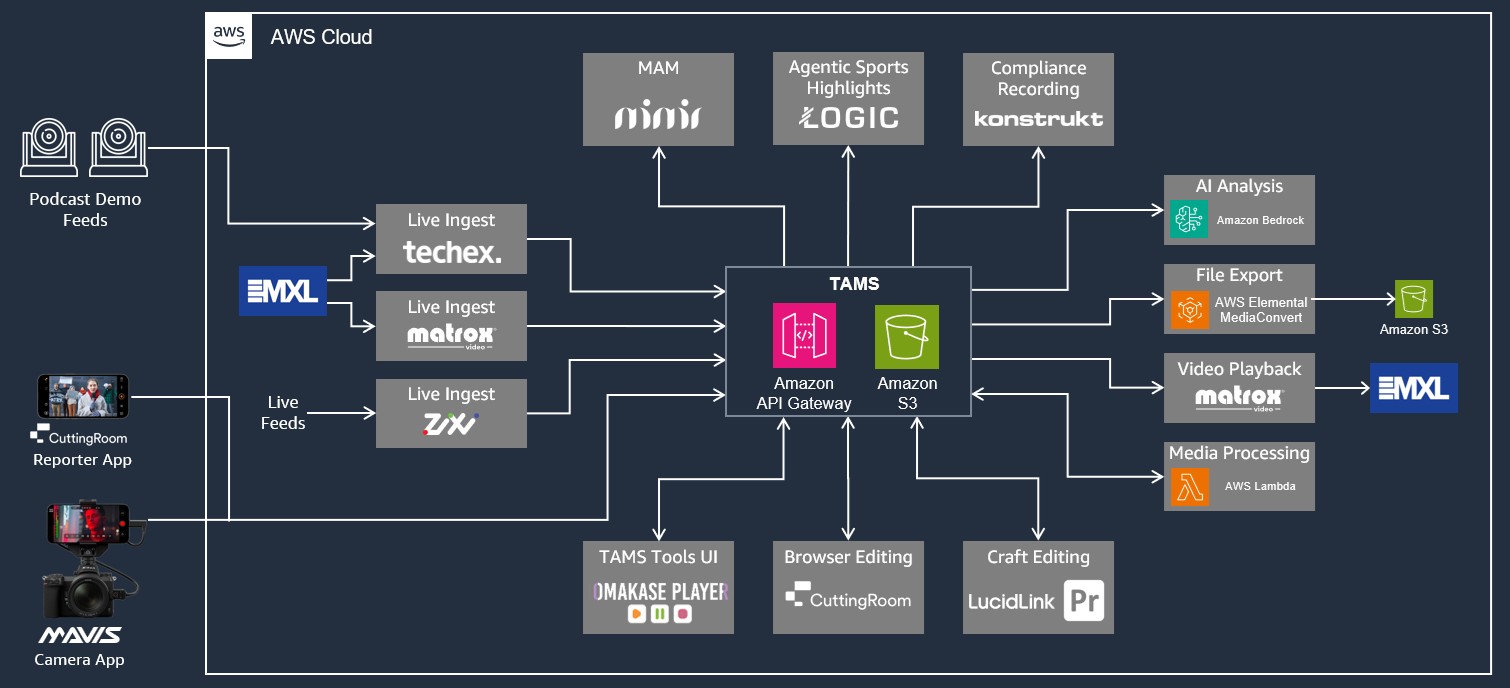
<p><img src="/images/blog_images/2026-nab-demo-diagram.png" alt="Diagram of the TAMS demo at the AWS Booth" /></p>

<h2 id="fast-turnaround-workflows-using-tams">Fast-turnaround workflows using TAMS</h2>

<div style="text-align: center;">
<iframe width="720" height="405" src="https://www.youtube.com/embed/zpzz-mMwIZo?si=q6iNbphekmAlJ700" title="YouTube video player" frameborder="0" allow="accelerometer; autoplay; clipboard-write; encrypted-media; gyroscope; picture-in-picture; web-share" referrerpolicy="strict-origin-when-cross-origin" allowfullscreen=""></iframe>
</div>

<h2 id="live-video-intelligence-with-tams-and-agentic-ai">Live video intelligence with TAMS and agentic AI</h2>

<div style="text-align: center;">
<iframe width="720" height="405" src="https://www.youtube.com/embed/x6Lv0Bb5n48?si=pbLRi9ymssdHITLY" title="YouTube video player" frameborder="0" allow="accelerometer; autoplay; clipboard-write; encrypted-media; gyroscope; picture-in-picture; web-share" referrerpolicy="strict-origin-when-cross-origin" allowfullscreen=""></iframe>
</div>]]></content><author><name>John Biltcliffe</name></author><category term="NAB" /><category term="Trade Show" /><category term="Demo" /><category term="AWS" /><summary type="html"><![CDATA[Since not everyone was able to attend NAB this year then AWS have provided video walkthroughs of the TAMS demos from the show. While this does not fully replace seeing the demo in person, this will hopefully give an indication of what was shown.]]></summary><media:thumbnail xmlns:media="http://search.yahoo.com/mrss/" url="https://tams.org/images/blog_images/2026-nab-show-logo.png" /><media:content medium="image" url="https://tams.org/images/blog_images/2026-nab-show-logo.png" xmlns:media="http://search.yahoo.com/mrss/" /></entry><entry><title type="html">NAB 2026 TAMS Locations</title><link href="https://tams.org/2026/04/16/NAB2026/" rel="alternate" type="text/html" title="NAB 2026 TAMS Locations" /><published>2026-04-16T00:00:00+00:00</published><updated>2026-04-16T00:00:00+00:00</updated><id>https://tams.org/2026/04/16/NAB2026</id><content type="html" xml:base="https://tams.org/2026/04/16/NAB2026/"><![CDATA[<p>With NAB 2026 rapidly approaching we’ve put together a list of some of the places where you can see or talk about the latest developments in the TAMS eco system.</p>

<p>As with previous trade shows, the main multi-vendor demonstration will be on the AWS booth.  However with more and more products supporting TAMS then we wanted to provide a simple guide on where to find TAMS around the show.</p>

<h2 id="aws-w1701">AWS (W1701)</h2>

<p>The AWS booth will once again host a multi-partner TAMS demo bringing together many of the latest developments in the TAMS eco-system in one place.  The demo will include TAMS native camera to cloud, integrations between TAMS and the EBU Media Exchange Layer (MXL), new and updated editing capabilities, compliance recording capabilities plus generative AI for near live video understanding and agentic workflows.</p>

<p><img src="/images/blog_images/2026-nab-demo-diagram.png" alt="Diagram of the TAMS demo at the AWS Booth" /></p>

<h2 id="cuttingroom-n2172">CuttingRoom (N2172)</h2>

<p>Edit directly from your TAMS store in the CuttingRoom Cloud Editor. Add growing TAMS recordings even directly to your timeline.  Shoot directly to your TAMS store with the mobile news gathering app CuttingRoom Reporter, enabling editing while shooting.</p>

<p><a href="https://www.cuttingroom.com">https://www.cuttingroom.com</a></p>

<h2 id="konstrukt">Konstrukt</h2>

<p>Konstrukt’s Compliance Vault gives media companies a frame‑accurate, reliable, and readily available record of everything that goes to air or online, along with the ability to act on it quickly. Built as a cloud‑native workflow on TAMS, Compliance Vault lets media teams record once and reuse the same time‑indexed media across applications well beyond compliance. The record‑once model, combined with a serverless architecture, makes the solution’s economics attractive and cost‑optimized. Using Omakase Player (player.byomakase.org), the native TAMS player included in the open‑source TAMS reference implementation, Compliance Vault provides teams with a browser‑based application to efficiently review, edit, and export media.</p>

<table>
  <tbody>
    <tr>
      <td><a href="https://bykonstrukt.com">https://bykonstrukt.com</a></td>
      <td><a href="https://player.byomakase.org">https://player.byomakase.org</a></td>
    </tr>
  </tbody>
</table>

<h2 id="logic-media-solutions-gmbh">LOGIC media solutions GmbH</h2>

<p>LOGIC’s modular platform demonstrates how we build custom, cloud-native media workflows based on TAMS. Using a soccer highlight use case as a reference implementation, it shows how modules such as ingest, playback, edit-by-reference, event-driven highlight processing, and AI can be combined into tailored workflows for specific workflows and requirements rather than one-size-fits-all systems. The project is shortlisted for the IABM Impact Awards 2026 in the Transformational Project Award category.</p>

<p><a href="https://logic.tv/">https://logic.tv/</a></p>

<h2 id="lucidlink-n2940">LucidLink (N2940)</h2>

<p>LucidLink Connect revolutionises the creative workflow by seamlessly integrating TAMs Store with any NLE. Leveraging advanced file-streaming technology, it enables editors to access and edit growing files in real time, eliminating the need for local downloads or cumbersome transfers.</p>

<p><a href="https://www.lucidlink.com/events/nab-2026">https://www.lucidlink.com/events/nab-2026</a></p>

<h2 id="matrox-n2451">Matrox (N2451)</h2>

<p>Matrox ORIGIN is SDK that allows developers to build media application using simple REST APIs.  It provides a complete suite of media processing functions including TAMS readers and writers.  In the demo, ORIGIN plays back flows from TAMS into ORIGIN Fabric which are also available in MXL, at the same time, ORIGIN/MXL flows are written into TAMS</p>

<p><a href="https://video.matrox.com/en/products/broadcast-media/origin-series">https://video.matrox.com/en/products/broadcast-media/origin-series</a></p>

<h2 id="mavis-n2161">Mavis (N2161)</h2>

<p>Mavis Camera is designed to connect a wide range of acquisition sources into modern production workflows. In this demo, we extend our existing camera-to-cloud workflows by supporting TAMS from the internal iPhone camera and external HDMI and SDI sources through devices such as Atomos Ninja Phone and the Accsoon SeeMo range. This shows how Mavis can bridge traditional video hardware and cloud-native production, bringing signals from professional cameras and other external gear into the same real-time workflow.</p>

<p><a href="https://mavis.cloud">https://mavis.cloud</a></p>

<h2 id="mimir-n2850">Mimir (N2850)</h2>

<p>Mimir is a cloud-native platform that simplifies how creative teams manage their media. It acts as a unified “brain” for your assets, allowing editors to find and use files instantly without worrying about where they are physically stored. Whether your high-res footage is on a local server, a NAS, or in the cloud (like AWS S3 or TAMS), Mimir handles the technical logistics so you can stay focused on the storytelling.</p>

<p><a href="https://onemimir.com/news/see-mimir-at-nab-2026">https://onemimir.com/news/see-mimir-at-nab-2026</a></p>

<h2 id="norsk-w3113">Norsk (W3113)</h2>

<p>Norsk’s TAMS (Time-Addressable Media Store) integration enables live content to become immediately queryable as it’s captured, eliminating the traditional boundary between live production and VOD workflows. TAMS, an open-source specification developed by BBC R&amp;D and now adopted by AWS, Adobe, Sky, and others, stores segmented media in cloud object storage with HTTP API access indexed by timeline position. Norsk’s MediaStore component brings this capability natively into Norsk Studio workflows.</p>

<p><a href="https://norsk.video">https://norsk.video</a></p>

<h2 id="reuters-imagen-w1624">Reuters Imagen (W1624)</h2>

<p>Reuters Imagen provides real-time activation of live content through multi‑cloud TAMS ingest. Automated enrichment against the content in TAMS ensures live assets are immediately discoverable, enriched, and available for downstream automation and use.</p>

<p><a href="https://imagen.io">https://imagen.io</a></p>

<h2 id="techex-w2267">Techex (W2267)</h2>

<p>tx darwrin provides comprehensive manipulation and syncrhonisation of transport streams ahead of writing to a TAMS store. tx darwin is a software platform which runs in the cloud or on-prem supporting compressed or uncompressed media workflows. Now, it’s possible to synchronise miltiple feeds on writing, write as multiple essences or a single combined stream and even perform video.and audio confromance ahead of a TAMS media store.</p>

<p><a href="https://imagen.io">https://techex.tv</a></p>

<h2 id="zixi-w2057">Zixi (W2057)</h2>

<p>Zixi enables broadcasters to bridge live streaming workflows with TAMS-based VOD environments. At NAB, Zixi will demonstrate how live streams can be ingested and written as assets into a TAMS store, making live content immediately available for downstream clipping, archive, compliance, and monetization workflows. ZEN Master provides orchestration, monitoring, and per-stream or per-event control for flexible and reliable operations</p>

<p><a href="https://zixi.com">https://zixi.com</a></p>]]></content><author><name>John Biltcliffe</name></author><category term="NAB" /><category term="Trade Show" /><category term="Techex" /><category term="Reuters" /><category term="Demo" /><summary type="html"><![CDATA[With NAB 2026 rapidly approaching we’ve put together a list of some of the places where you can see or talk about the latest developments in the TAMS eco system.]]></summary><media:thumbnail xmlns:media="http://search.yahoo.com/mrss/" url="https://tams.org/images/blog_images/2026-nab-show-logo.png" /><media:content medium="image" url="https://tams.org/images/blog_images/2026-nab-show-logo.png" xmlns:media="http://search.yahoo.com/mrss/" /></entry><entry><title type="html">Two New Appointments to the TAMS TSC</title><link href="https://tams.org/2026/04/15/new-tsc-members/" rel="alternate" type="text/html" title="Two New Appointments to the TAMS TSC" /><published>2026-04-15T00:00:00+00:00</published><updated>2026-04-15T00:00:00+00:00</updated><id>https://tams.org/2026/04/15/new-tsc-members</id><content type="html" xml:base="https://tams.org/2026/04/15/new-tsc-members/"><![CDATA[<p>The Time Addressable Media Store (TAMS) project today announced the appointment of James Elliott (Elliott Media) and Glenn Pedersen (CuttingRoom) to its initial Technical Steering Committee (TSC), marking a significant milestone in the project’s transition to full open source governance.</p>

<p>This expansion of the initial TSC represents an important step towards establishing comprehensive open governance for TAMS. As announced in the 28th January 2026 blog post <a href="/2026/02/06/tsc-members.html">“Moving TAMS towards Open Governance,”</a> the TAMS project is transitioning from BBC Research &amp; Development ownership to community ownership under an open governance model. The move recognises that as more systems, solutions, and products are built on TAMS, the technology should be owned by the community rather than any single organisation.</p>

<p>The initial committee’s primary mandate will be to define the open source strategy for TAMS and select the appropriate governance organisation to oversee the project’s future development. “The formation of this initial TSC is a crucial phase in TAMS’s evolution,” said Sam Mesterton-Gibbons, Chair of the TAMS Technical Steering Committee. “Once the governance framework is established, a full TSC will be appointed to guide the long-term technical direction of the project.”</p>

<p>The two new TSC members bring valuable industry perspective to the committee:</p>

<p>“CuttingRoom has been involved with TAMS for the last two years, and we’ve seen how it can revolutionise media workflows,” said Glenn Pedersen of CuttingRoom. “Joining the initial TSC allows us to help ensure TAMS develops in a way that serves the entire industry.”</p>

<p>“Being part of the award-winning news demo at IBC 2025 showed me firsthand the transformative potential of TAMS,” said James Elliott of Elliott Media. “I’m excited to contribute to shaping its open source future and helping the industry realise the full benefits of this technology.”</p>

<h3 id="current-tsc-members">Current TSC Members</h3>

<p>The TSC purposefully brings together a balanced mix of technology vendors, broadcasters, and TAMS customers, alongside the BBC Research &amp; Development team that has been instrumental in developing the TAMS specification.</p>

<p>The TAMS initial Technical Steering Committee is composed of the following members:</p>

<ul>
  <li>Sam Mesterton-Gibbons (BBC) - Chair</li>
  <li>James Sandford (BBC)</li>
  <li>Richard Lynton-Evans (BBC)</li>
  <li>John Biltcliffe (AWS)</li>
  <li>Chris Swan (AWS)</li>
  <li>James Elliott (Elliott Media)</li>
  <li>Glenn Pedersen (CuttingRoom)</li>
</ul>

<p>Following this transition period, once the governance framework is established, it is expected that the TSC will be rebalanced so that no organisation controls more than one vote. All those who applied to join the TSC in this round will be invited back at that point to be considered for the updated TSC, plus there will be the opportunity for new individuals to express their interest.</p>]]></content><author><name>Sam Mesterton-Gibbons</name></author><category term="Governance" /><category term="TSC" /><category term="Community" /><summary type="html"><![CDATA[The Time Addressable Media Store (TAMS) project today announced the appointment of James Elliott (Elliott Media) and Glenn Pedersen (CuttingRoom) to its initial Technical Steering Committee (TSC), marking a significant milestone in the project’s transition to full open source governance.]]></summary><media:thumbnail xmlns:media="http://search.yahoo.com/mrss/" url="https://tams.org/images/blog_images/tams-tsc-selection-cropped.png" /><media:content medium="image" url="https://tams.org/images/blog_images/tams-tsc-selection-cropped.png" xmlns:media="http://search.yahoo.com/mrss/" /></entry><entry><title type="html">TAMSCon Agenda Now Available</title><link href="https://tams.org/2026/03/02/tamscon-agenda/" rel="alternate" type="text/html" title="TAMSCon Agenda Now Available" /><published>2026-03-02T00:00:00+00:00</published><updated>2026-03-02T00:00:00+00:00</updated><id>https://tams.org/2026/03/02/tamscon-agenda</id><content type="html" xml:base="https://tams.org/2026/03/02/tamscon-agenda/"><![CDATA[<p>The full programme for the TAMSCon is now available to download and view.</p>

<p>Please note: the in person option is now full however you can still sign up to attend TAMSCon virtually.  Click <a href="https://aws-experience.com/emea/uki/e/dec59/tamscon-1">here to sign up</a>.</p>

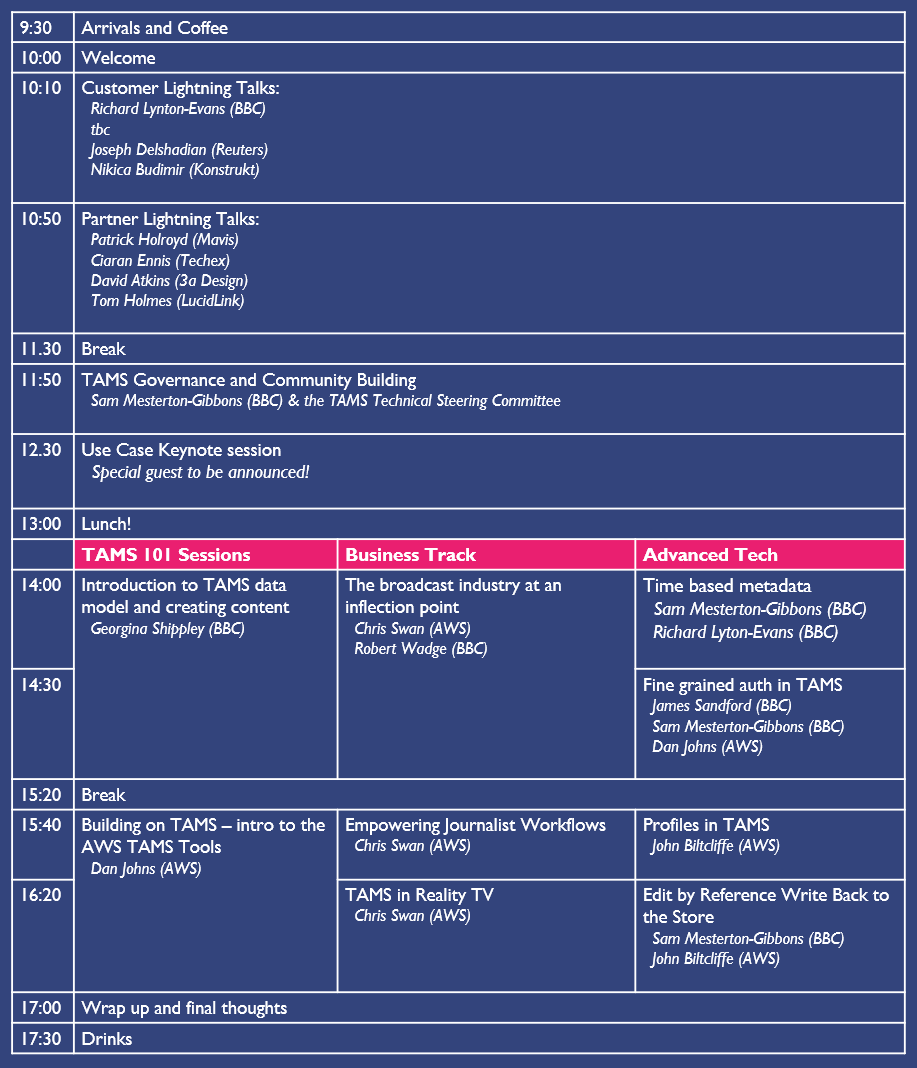
<h3 id="day-1">Day 1</h3>

<p>Day 1 of TAMSCon will focus on the highest priority topics in the community today.  With updates from key customers and partners to how TAMS will be governed going forward.  In the afternoon there will be multiple talk tracks providing session from those that are new to TAMS to diving into some of the latest developments.  For the non-technical there is a dedicated business track to understand the value that TAMS can bring</p>

<p><img src="/images/blog_images/tamscon1-agenda-day1.png" alt="Day 1 Full Agenda" /></p>

<h3 id="day-2">Day 2</h3>

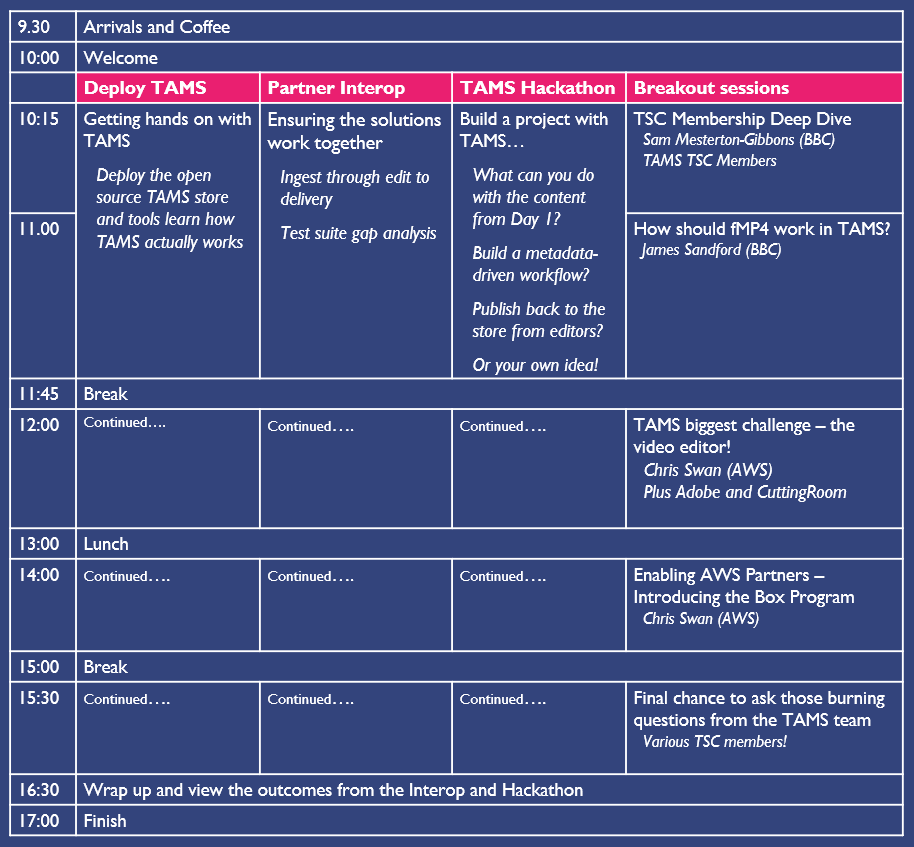
<p>Day 2 of TAMSCon is a hands-on day, with attendees free to move between practical activities and formal <strong>Breakout Sessions</strong> throughout.  All tracks will be available to both virtual and in person attendees.</p>

<p><strong>Deploy TAMS</strong> is ideal for those new to TAMS, offering the chance to deploy your own personal TAMS instance, use the API to create content, and explore the open-source TAMS Tools across a variety of workflows.</p>

<p><strong>Partner Interop</strong> gives vendors the opportunity to test solutions end-to-end - from ingest and playback through to editing and export - as well as contribute ideas for a formal TAMS test suite.</p>

<p><strong>TAMS Hackathon</strong> is for those with existing TAMS knowledge, development skills, or a willingness to vibe code. A content store will be provided - including sessions from Day 1 - giving you the chance to build something new and share it with the group.</p>

<p><strong>Drop-in Expert Sessions</strong> are available throughout the day. Whether you have technical questions, want to explore the benefits of TAMS, or discuss how it fits your workflows, the TAMS experts will be on hand to help.</p>

<p><img src="/images/blog_images/tamscon1-agenda-day2.png" alt="Day 2 Full Agenda" /></p>

<h3 id="download">Download</h3>

<p>The whole agenda can be downloaded <a href="/files/TAMSCon1_Agenda.pdf">here</a></p>]]></content><author><name>John Biltcliffe</name></author><category term="TAMSCon" /><category term="Events" /><category term="Community" /><summary type="html"><![CDATA[The full programme for the TAMSCon is now available to download and view.]]></summary><media:thumbnail xmlns:media="http://search.yahoo.com/mrss/" url="https://tams.org/images/blog_images/tamscon1.png" /><media:content medium="image" url="https://tams.org/images/blog_images/tamscon1.png" xmlns:media="http://search.yahoo.com/mrss/" /></entry><entry><title type="html">TVBEurope Webinar and Article</title><link href="https://tams.org/2026/02/27/TVBEurope-Webinar/" rel="alternate" type="text/html" title="TVBEurope Webinar and Article" /><published>2026-02-27T00:00:00+00:00</published><updated>2026-02-27T00:00:00+00:00</updated><id>https://tams.org/2026/02/27/TVBEurope-Webinar</id><content type="html" xml:base="https://tams.org/2026/02/27/TVBEurope-Webinar/"><![CDATA[<p>TVBEurope and Techex webinar ‘Is it Primetime for TAMS?’ is now available to watch online, plus a dedicated article on the TVBEurope website.</p>

<h3 id="webinar-available-online">Webinar available online</h3>

<p><img src="/images/blog_images/2026-tvbeurope-webinar.png" alt="Screenshot from webinar" /></p>

<p>On Thursday 12th February 12th TVBEurope and techex hosted a webinar to explore what TAMS is, its global potential, and the agility it can deliver in near-live editing and production workflows.  The webinar was chaired by Jenny Priestley (Content Director, TVBEurope) and will featured contributions from:</p>

<ul>
  <li>Dave Mitchinson (Solutions Director, Techex)</li>
  <li>Kevin Morris (Product Manager, BBC)</li>
  <li>John Biltcliffe (Senior Solutions Architect, AWS)</li>
  <li>James Elliott (Managing Director, Elliott Media)</li>
  <li>Rebecca Light (Group Head of Content Mngmt &amp; Quality Control - Content Technology &amp; Innovation, Sky)</li>
</ul>

<p>The webinar is now available online.  Head to the <a href="https://events.futureb2b.com/on-demand/1831/is-it-primetime-for-tams//">website</a> and register to be able to watch the whole session.</p>

<h3 id="tvbeurope-article">TVBEurope article</h3>

<p>TVBEurope has also taken some of the key themes and discussion topics from the webinar and published them as a dedicated article.  This can be viewed online at the <a href="https://www.tvbeurope.com/live-production/how-tams-is-revolutionising-media-workflows-for-agility-and-scale">TVBEurope website</a></p>]]></content><author><name>John Biltcliffe</name></author><category term="Press" /><category term="TVBEurope" /><category term="Techex" /><summary type="html"><![CDATA[TVBEurope and Techex webinar ‘Is it Primetime for TAMS?’ is now available to watch online, plus a dedicated article on the TVBEurope website.]]></summary><media:thumbnail xmlns:media="http://search.yahoo.com/mrss/" url="https://tams.org/images/blog_images/2026-tvbeurope-webinar-header.png" /><media:content medium="image" url="https://tams.org/images/blog_images/2026-tvbeurope-webinar-header.png" xmlns:media="http://search.yahoo.com/mrss/" /></entry><entry><title type="html">TAMSCon Community Event</title><link href="https://tams.org/2026/02/12/tamscon-signup/" rel="alternate" type="text/html" title="TAMSCon Community Event" /><published>2026-02-12T00:00:00+00:00</published><updated>2026-02-12T00:00:00+00:00</updated><id>https://tams.org/2026/02/12/tamscon-signup</id><content type="html" xml:base="https://tams.org/2026/02/12/tamscon-signup/"><![CDATA[<p>Signup is now available for the the first ever TAMS Community event TAMSCon.</p>

<h3 id="tuesday-10th-and-wednesday-11th-march">Tuesday 10th and Wednesday 11th March</h3>

<p>The first ever TAMSCon will bring together the whole TAMS community for the first time.  We want to share with the community some of the progress over the last 12 months, as well as look forward to what is coming up in 2026.  This session is for those that have been in the community since the start or may just be starting to look at TAMS.  Session will be held principally in London at the AWS office in Holborn, but there will be option for virtual participation.</p>

<h3 id="day-1">Day 1</h3>
<p>The morning will be a set of presentations including:</p>

<ul>
  <li>Updates from some key customers on where they are in their TAMS adoption journeys</li>
  <li>Quick fire sessions from a selection of new partners who have deployed TAMS support in their products</li>
  <li>An update on the TAMS Governance and a chance to ask questions about what it means</li>
</ul>

<p>The afternoon will break out into a set of different tracks:</p>

<ol>
  <li>For those new to TAMS there will be a 101 stream focusing on what TAMS is and how it works</li>
  <li>A focus on what TAMS means for business leaders and operational teams</li>
  <li>Advanced technical sessions focusing on some of the proposed changes to the TAMS specification</li>
</ol>

<p>The day will end with drinks and a chance to network</p>

<h3 id="day-2">Day 2</h3>
<p>The second day is a more informal session and is not mandatory to attend both days.  The day will include 3 key workstreams:</p>

<ol>
  <li>
    <p>For partners with TAMS capable products, there will be a chance to test interoperability between them and focus on ensuring consistency across the TAMS experience.</p>
  </li>
  <li>
    <p>We will be running a hands-on workshop for those new to TAMS who would like to dive deeper and understand it better.  This will include deploying a TAMS instance, creating content and then deploying the TAMS Tools to interact with the store.</p>
  </li>
  <li>
    <p>A drop in TAMS Surgery will be avialable with experts on hand to answer questions, talk through workflows and help think about what TAMS could mean for your company.</p>
  </li>
</ol>

<h3 id="sign-up">Sign up</h3>
<p><a href="https://aws-experience.com/emea/uki/e/dec59/tamscon-1">Sign up here</a></p>]]></content><author><name>John Biltcliffe</name></author><category term="TAMSCon" /><category term="Events" /><category term="Community" /><summary type="html"><![CDATA[Signup is now available for the the first ever TAMS Community event TAMSCon.]]></summary><media:thumbnail xmlns:media="http://search.yahoo.com/mrss/" url="https://tams.org/images/blog_images/tamscon1.png" /><media:content medium="image" url="https://tams.org/images/blog_images/tamscon1.png" xmlns:media="http://search.yahoo.com/mrss/" /></entry></feed>